Choose your continent:)

среда, 11 июня 2014 г.

#71 - Kaliningrad Oblast, Russia (privat swap)


Kaliningrad Oblast is a federal subject of Russia (an oblast). It is an exclave, with no land connection to the rest of Russia, on the Baltic coast. It has a population of 941,873 (2010 Census).
The territory of the Kaliningrad Oblast is that of the northern part of historical East Prussia (German: Nord-Ostpreussen), which was an exclave of Germany from World War I until 1945. That year, it was occupied by the Soviet Union, whose armies remained until the war ended. The region was later annexed to the Soviet Union under border changes promulgated in the Potsdam Agreement, when it was attached to the Russian Soviet Federative Socialist Republic. Most of its indigenous German population were killed or fled westward to what would become West Germany during the last months of the war.The rest were expelled between 1944 and 1950. Russian settlers were moved in and the population has been majority Russian ever since.

#70 - Russia (privat swap)


The Sikorsky Russky Vityaz, or Russian Knight and previously known as the Bolshoi Baltisky in its first four-engined version, was the first four-engine aircraft in the world, designed by Igor Sikorsky and built at the Russian Baltic Railroad Car Works in Saint Petersburg in early 1913.

#69 - Russia (privat swap)


The Trans-Siberian Railway (TSR, Transsibirskaya Magistral') is a network of railways connecting Moscow with the Russian Far East and the Sea of Japan. With a length of 9,289 km (5,772 mi), it is the longest railway line in the world. There are connecting branch lines into Mongolia, China and North Korea. It has been connecting Moscow with Vladivostok since 1916 and is still being expanded.

#68 - Hypsometric map of the Russian Empire, Russia (privat swap)


The Russian Empire was a state that existed from 1721 until overthrown by the short-lived liberal February Revolution in 1917. One of the largest empires in world history, stretching over three continents, the Russian Empire was surpassed in landmass only by the British and Mongol empires. It played a major role in 1812–14 in defeating Napoleon's ambitions to control Europe, and expanded to the west and south. It was often in conflict with the Ottoman Empire (which in turn was usually protected by the British).

#67 - Birds of Russia, Russia (privat swap)


#66 - Animals of Russia, Russia (privat swap)


Wildlife Russia - all representatives of the animal world (Animalia), living on the territory of Russia . Vertebrates alone there in Russia> 1300 species , and insects > 70,000 species.

#65 - Russia (privat swap)


A matryoshka doll, also known as Russian nesting doll, refers to a set of wooden dolls of decreasing size placed one inside the other. The first Russian nested doll set was carved in 1890 by Vasily Zvyozdochkin from a design by Sergey Malyutin, who was a folk crafts painter at Abramtsevo. Traditionally the outer layer is a woman, dressed in a sarafan, a long and shapeless traditional Russian peasant jumper dress. The figures inside may be of either gender; the smallest, innermost doll is typically a baby turned from a single piece of wood. Much of the artistry is in the painting of each doll, which can be very elaborate. The dolls often follow a theme; the themes vary, from fairy tale characters to Soviet leaders.

#64 - Russia (privat swap)


Red caviar is a caviar made from the roe of pacific, atlantic specia and river salmon. Given its high price in the West, red caviar is associated with luxury and wealth, but in Russia, Norway and Japan, caviar is commonly served at holiday feasts, weddings and other festive occasions.
See more

#63 - Russia (privat swap)


This is a list of cities and towns in Russia with the population of over 50,000 as of the 2010 Census. These numbers are the population within the limits of the city/town proper, not the urban area or metropolitan area figures.
Administrative centers and capitals of the federal subjects are shown in bold.
The list excludes the city of Sevastopol and the cities/towns of the Republic of Crimea, as those were not a part of the 2010 Census, are a subject of an unresolved dispute between Russia and Ukraine, and are considered to be a part of Ukraine by international law.
The city of Zelenograd (a part of the federal city of Moscow) and the municipal cities/towns of the federal city of St. Petersburg are also excluded, as they are not enumerated in the 2010 Census as stand-alone localities.

#62 - Russia (privat swap)
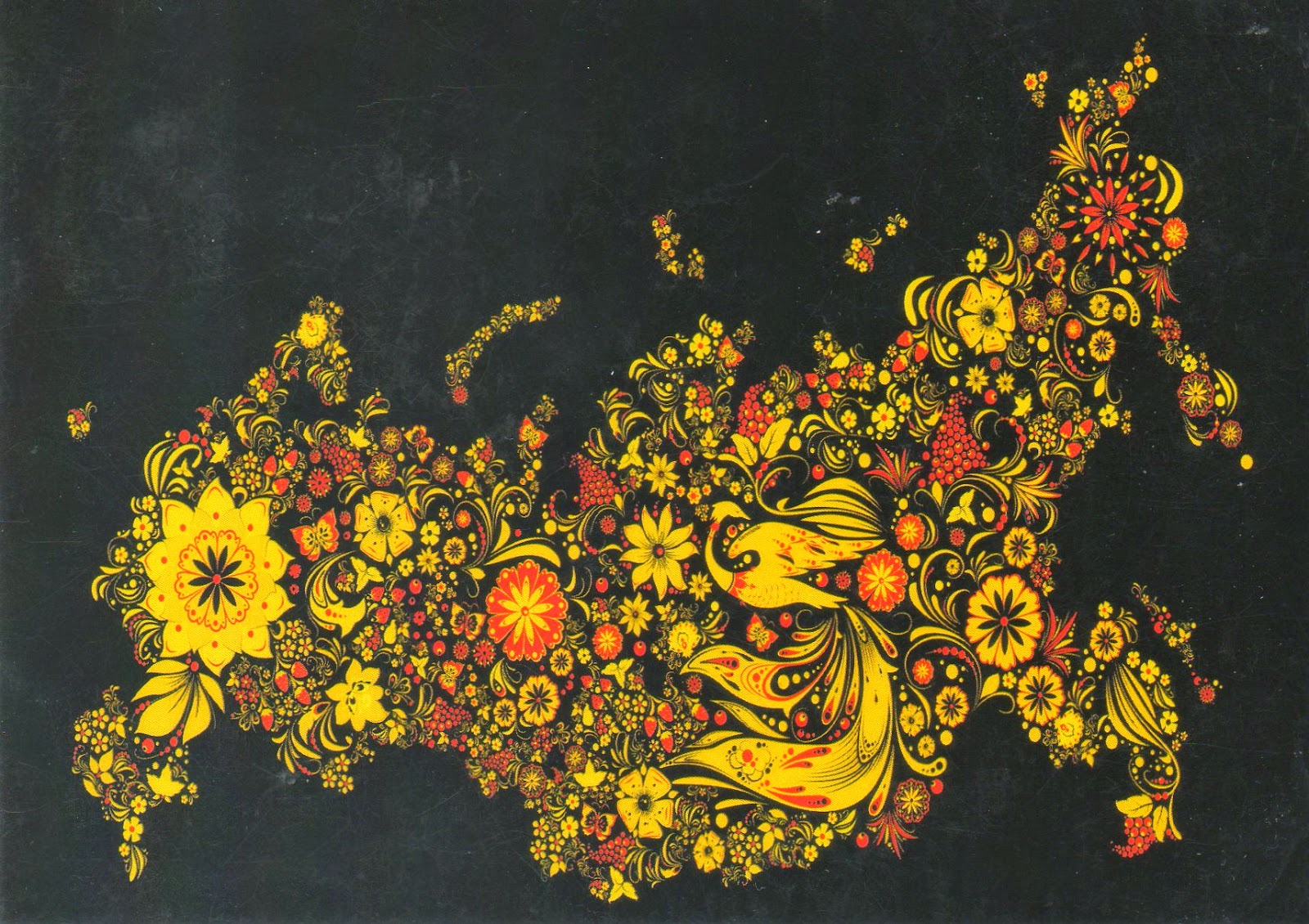


Khokhloma or Khokhloma painting is the name of a Russian wood painting handicraft style and national ornament, known for its vivid flower patterns, red and gold colors over a black background, and the effect it has when applied to wooden tableware or furniture, making it look heavier and metal-like.
See more

вторник, 27 августа 2013 г.

#30- Kamchatka Peninsula, Russia (privat swap)


The Kamchatka Peninsula is a 1,250-kilometre (780 mi) peninsula in the Russian Far East, with an area of about 270,000 km2. It lies between the Pacific Ocean to the east and the Sea of Okhotsk to the west. Immediately offshore along the Pacific coast of the peninsula runs the 10,500-metre (34,400 ft) deep Kuril-Kamchatka Trench.

#29- The Republic of Bashkortostan, Russia (privat swap)


The Republic of Bashkortostan also known as Bashkiria. It is located between the Volga River and the Ural Mountains. Its capital is the city of Ufa. Population: 4,072,292 (2010 Census). Bashkortostan is the largest republic in Russia with a population of 4.1 million.

#28- Vladimir region, Russia (privat swap)


Vladimir Oblast is a federal subject of Russia (an oblast). Its administrative center is the city of Vladimir, which is located 190 kilometers (120 mi) east of Moscow. Population: 1,443,693 (2010 Census).
The 12th-century cathedrals of Vladimir, Suzdal, Bogolyubovo, and Kideksha are inscribed on the UNESCO World Heritage List.

понедельник, 26 августа 2013 г.

#27- Neva river, S.-Petersburg, Russia (privat swap)


The Neva is a river in northwestern Russia flowing from Lake Ladoga through the western part of Leningrad Oblast (historical region of Ingria) to the Neva Bay of the Gulf of Finland. Despite its modest length (74 km), it is the third largest river in Europe in terms of average discharge (after the Volga and the Danube).

воскресенье, 4 августа 2013 г.

#17- Russia, Tomsk city (privat swap)


Tomsk was established under a decree from Tsar Boris Godunov in 1604 after Toyan, the Tatar duke of Eushta, asked for the Tsar's protection against Kirghiz bandits. The Tsar sent 200 Cossacks under the command of Vasily Tyrkov and Gavriil Pisemsky to construct a fortress on the bank of the Tom River, overlooking what would become the city of Tomsk. Toyan ceded the land for the fortress to the Tsar.

#16- Russia, Irkutsk city (privat swap)


In 1652, Ivan Pokhabov built a zimovye (winter quarters) near the site of Irkutsk for gold trading and for the collection of fur taxes from the Buryats. In 1661, Yakov Pokhabov built an ostrog nearby. The ostrog gained official town rights from the government in 1686. The first road connection between Moscow and Irkutsk, the Siberian Road, was built in 1760, and benefited the town economy. Many new products, often imported from China via Kyakhta, became widely available in Irkutsk for the first time, including gold, diamonds, fur, wood,silk and tea. In 1821, as part of the Speransky reforms, Siberia was administratively divided at the Yenisei River and Irkutsk became the seat of the Governor-General of East Siberia.

#15- Early Russia (privat swap)


The early history of Russia, like those of many countries, is one of migrating peoples and ancient kingdoms. In fact, early Russia was not exactly "Russia," but a collection of cities that gradually coalesced into an empire. I n the early part of the ninth century, as part of the same great movement that brough the Danes to England and the Norsemen to Western Europe, a Scandanavian people known as the Varangians crossed the Baltic Sea and landed in Eastern Europe. The leader of the Varangians was the semilegendary warrior Rurik, who led his people in 862 to the city of Novgorod on the Volkhov River. Whether Rurik took the city by force or was invited to rule there, he certainly invested the city. From Novgorod, Rurik's successor Oleg extended the power of the city southward. In 882, he gained control of Kiev, a Slavic city that had arisen along the Dnepr River around the 5th century. Oleg's attainment of rule over Kiev marked the first establishment of a unified, dynastic state in the region. Kiev became the center of a trade route between Scandinavia and Constantinople, and Kievan Rus', as the empire came to be known, flourished for the next three hundred years.

#14- Russia, Moscow city (privat swap)


Moscow is the capital city and the most populous federal subject of Russia. The city is a major political, economic, cultural and scientific center in Russia and in Eurasia. According to Forbes 2012, Moscow has the second largest community of billionaires in the world. Moscow is the northernmost megacity on Earth, the most populous city in Europe, and the 5th largest city proper in the world. It is the largest city in Russia with a population, according to the 2010 Census, of 11,503,501. By its territorial expansion on July 1, 2012 southwest into the Moscow Oblast, the capital increased its area 2.5 times; from about 1,000 square kilometers (390 sq mi) up to 2,511 square kilometers (970 sq mi), and gained additional population of 233,000 people.

понедельник, 22 июля 2013 г.

#7- Russia (privat swap)


Russia , also officially known as the Russian Federation, is a country in northern Eurasia. It is a federal semi-presidential republic, comprising 83 federal subjects. From northwest to southeast, Russia shares land borders with Norway, Finland, Estonia, Latvia, Lithuania and Poland (both with Kaliningrad Oblast), Belarus, Ukraine,Georgia, Azerbaijan, Kazakhstan, China, Mongolia, and North Korea. It shares maritime borders with Japanby the Sea of Okhotsk, and the US state of Alaska across the Bering Strait. At 17,075,400 square kilometres (6,592,800 sq mi), Russia is the largest country in the world, covering more than one-eighth of the Earth's inhabited land area. Russia is also the world's ninth most populous nation with 143 million people as of 2012. Extending across the whole of northern Asia, Russia spans nine time zones and incorporates a wide range of environments and landforms.
See more